
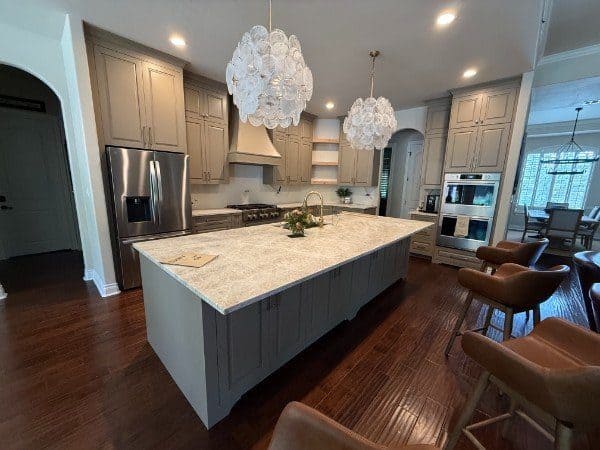
Quartzite countertops · San Antonio, TX
The look of marble with the toughness of granite. Pick your quartzite from full slabs in our warehouse, tested before we quote, then cut and installed by our own San Antonio crew.
Every slab tested before we quote · Fabricated in our West Turbo Drive shop · 1-year warranty on every countertop
Why quartzite
Quartzite starts as sandstone. Deep underground, heat and pressure fuse its quartz grains into one solid stone, which is why true quartzite is harder than granite and shrugs off lemon juice, vinegar and wine that would etch marble.
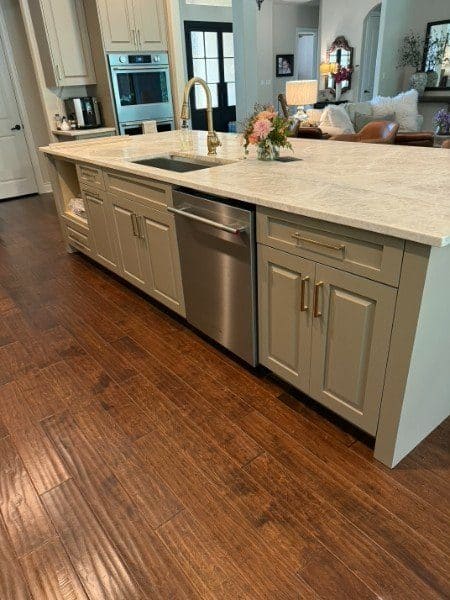
That is the appeal for San Antonio kitchens: white and soft-gray slabs with marble-like veining that can take a hot pan, a busy family and even Texas sun on an outdoor kitchen. Every slab is one of a kind, so you choose the exact piece that goes on your cabinets.
Quartzite is one of five stones we cut and finish in our own shop. See all of our countertops in San Antonio, including quartz, granite, marble and dolomite.
From our racks
White and soft-gray quartzite with marble-like veining is what most of our clients want, and bolder slabs make an island the focal point. These are slabs from our own inventory. Stock changes as slabs sell, so check what is on the racks before you visit.

Fusion
Triton quartzite

Mont Blanc
Triton quartzite

White Macaubus
Triton quartzite

Michelangelo
Triton quartzite

White Pearl
Quartzite, marble-like veining

Crema de Ci
Quartzite

Cygnas
Cosentino quartzite

Ocean Blue
Quartzite
Real or not
Some slabs sold as quartzite, often called soft quartzite, are really marble or dolomitic marble. They look the same on the rack, then scratch and etch like marble once they are in your kitchen. Three simple tests tell them apart.
1
Press a sharp edge of the stone across a glass tile. True quartzite scratches the glass. Marble does not.
2
A drop of dilute acid fizzes on marble and dolomite. True quartzite shows no reaction.
3
Leave lemon juice or vinegar on an unsealed spot for 15 minutes. Marble turns dull. Quartzite keeps its polish.
We check quartzite before we quote, so the stone on your estimate is the stone on your counters. Geologist Karin Kirk explains these tests in detail in Building Stone Magazine.
Pricing
Most quartzite countertops in San Antonio run about $75 to $160 per square foot installed. That covers the slab, fabrication, edge work and installation, not the material alone.
A typical kitchen uses about 45 square feet of countertop, so a common range is roughly $3,375 to $7,200 installed. Large islands, full-height backsplashes and waterfall ends add square footage.
Quotes over the phone are guesses. We give you a firm price after we measure, and the slab you pick in our warehouse is the slab on your cabinets.
The slab itself. Common whites sit lower in the range; sought-after names and dramatic veining sit at the top.
Fabrication time. Quartzite is harder than granite, so cutting, edging and polishing take longer.
Thickness. 3cm tops cost more than 2cm and need no plywood underlayment.
Edge profile. Eased and square edges are standard; ogee and mitered edges add shop time.
Vein matching. Lining up veins across seams on an island or long run takes careful layout, and sometimes an extra slab.
Cutouts and backsplash. Sinks, cooktops and a full-height slab backsplash each add work and material.

Compare
All four are on our racks, so we have no reason to push one over another. Here is how quartzite stacks up against engineered quartz countertops and the other natural stones in a San Antonio kitchen.
Quartzite
Quartz
Granite
Marble
What it is
Natural stone, sandstone fused by heat and pressure
Engineered stone, about 90% quartz bound with resin
Natural stone, quarried as whole slabs
Natural stone, softer and more porous
Scratches
Harder than granite
Resists scratches
Hard and scratch resistant
Scratches more easily
Lemon, wine, vinegar
Does not etch
Does not etch
Resists etching
Etches; acids dull the polish
Sealing
Depends on the slab; porous ones need it
Never needed
Recommended every year or two
Needs regular sealing
Heat
Handles hot pans well
Use trivets; direct heat can scorch the resin
Handles hot pans well
Tolerates heat well
Outdoor kitchens
A strong choice
Not recommended; sun can fade the resin
Our first pick
Not recommended
Look
Marble-like veining, every slab unique
Consistent color and pattern
Every slab is one of a kind
Classic veining, Calacatta and Carrara
Installed cost
$75 to $160 per sq ft
$50 to $110 per sq ft
$40 to $90 per sq ft
$65 to $150 per sq ft
Quartzite$75 to $160 / sq ft installed
What it is: Natural stone, sandstone fused by heat and pressure
Scratches: Harder than granite
Lemon, wine, vinegar: Does not etch
Sealing: Depends on the slab; porous ones need it
Heat: Handles hot pans well
Outdoor kitchens: A strong choice
Look: Marble-like veining, every slab unique
Quartz$50 to $110 / sq ft installed
What it is: Engineered stone, about 90% quartz bound with resin
Scratches: Resists scratches
Lemon, wine, vinegar: Does not etch
Sealing: Never needed
Heat: Use trivets; direct heat can scorch the resin
Outdoor kitchens: Not recommended; sun can fade the resin
Look: Consistent color and pattern
Granite$40 to $90 / sq ft installed
What it is: Natural stone, quarried as whole slabs
Scratches: Hard and scratch resistant
Lemon, wine, vinegar: Resists etching
Sealing: Recommended every year or two
Heat: Handles hot pans well
Outdoor kitchens: Our first pick
Look: Every slab is one of a kind
Marble$65 to $150 / sq ft installed
What it is: Natural stone, softer and more porous
Scratches: Scratches more easily
Lemon, wine, vinegar: Etches; acids dull the polish
Sealing: Needs regular sealing
Heat: Tolerates heat well
Outdoor kitchens: Not recommended
Look: Classic veining, Calacatta and Carrara
Quartzite has no resin to fade in South Texas sun, so it holds up on a patio where quartz does not. For outdoor kitchens our first pick is still granite countertops, and quartzite is the right call when you want a lighter, marble-like look outside.
FAQ
About $75 to $160 per square foot installed, which includes the slab, fabrication, edge work and installation. A typical 45 square foot kitchen runs roughly $3,375 to $7,200. We give a firm price after we measure.
Quartzite is natural stone, quarried as whole slabs. Quartz is engineered from crushed quartz and resin. Quartzite handles heat and sun better and every slab is unique; quartz never needs sealing and its color is consistent from slab to slab. Read our full quartz vs quartzite comparison.
Quartzite is harder than granite and gives you the light, marble-like look granite rarely does. Granite usually costs less and is our first pick for outdoor kitchens. We carry both and recommend based on the look you want and how you use the kitchen.
It depends on the slab. Dense quartzite needs little or no sealing, while more porous slabs such as White Macaubas benefit from a sealer. We tell you which applies to the slab you choose, and darkening around the sink is the sign it is time to reseal.
True quartzite does not etch from lemon juice, vinegar or wine. If a slab sold as quartzite etches, it is most likely marble or dolomite, which is why we check quartzite before we quote.
Yes. Quartzite has no resin to fade in the sun, so it holds up outdoors in South Texas. Granite is our first pick for outdoor kitchens, and quartzite is a strong choice when you want a lighter look.
We template once your cabinets are installed. From templating to install typically takes one to two weeks, depending on slab availability, edge details and your schedule.
Yes. Every quartzite countertop is cut, edged and polished in our own San Antonio shop and installed by our own crew. We do not send your slab out to another fabricator.
Ready when you are
Walk the racks at 203 W Turbo Dr, pick the exact slab for your kitchen, and get a firm price after we measure. Estimates are free.